How Calimero TEEs Work - Trusted execution environments explained
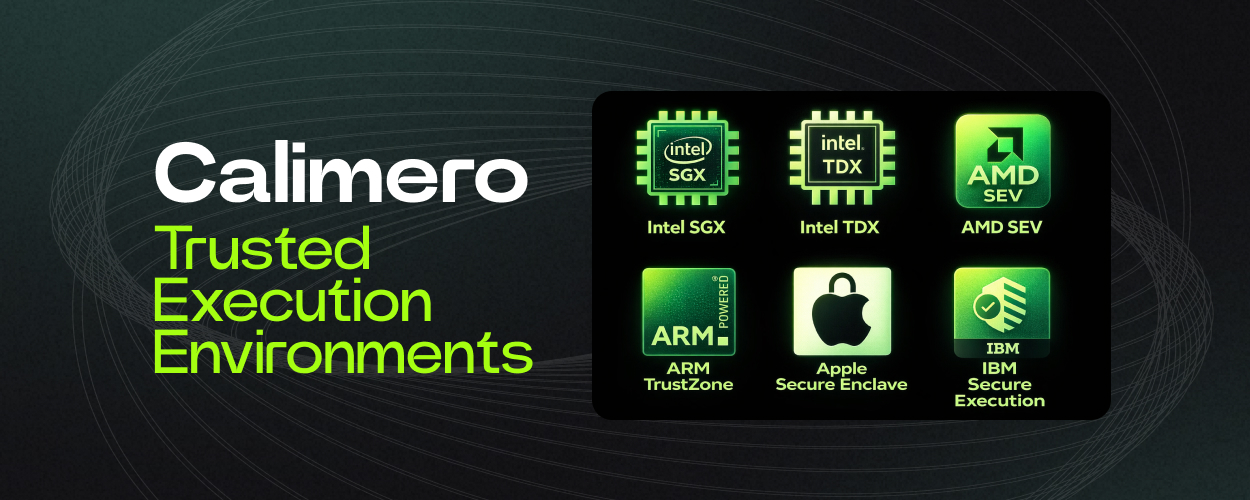
Why TEEs matter in the first place
One of the hardest problems in modern computing is not just encrypting data at rest or in transit.
It is protecting data while it is actively being used.
That is the awkward middle state where a normal system often becomes vulnerable:
- the data is decrypted
- the application is processing it
- the operating system can potentially inspect it
- a cloud operator or compromised host can become part of the trust problem
This is exactly the gap that Trusted Execution Environments, or TEEs, are designed to address.
The basic idea is simple: a TEE is a protected execution environment where code runs in isolated memory. The surrounding system is not supposed to read or tamper with what is happening inside.
In Calimero, TEEs are not just a security buzzword. They are part of a practical trust model for protecting private workloads and controlling key access.
What a TEE actually is
The easiest way to think about a TEE is as a secure room inside a larger computer.
The rest of the machine still exists — the operating system, the hypervisor, the cloud infrastructure, the hardware platform — but the sensitive code and data inside the secure room are isolated from the rest.
That isolation is enforced by hardware-backed mechanisms, not just by software policy.
So when a program runs inside a TEE:
- its memory is protected
- its execution can be measured
- remote systems can verify what code is running before trusting it
Security is not only about hiding code in a protected box. It is also about being able to prove what is inside the box.
TEEs are not magic
Note: Before going deeper, it helps to be precise about what TEEs do and do not solve.
A TEE helps with:
- isolating execution
- protecting memory from the surrounding host
- proving code identity through attestation
- establishing stronger trust for sensitive operations
A TEE does not automatically solve:
- bad application logic
- weak access control
- insecure key management outside the trusted flow
- every possible side-channel or operational mistake
The value of a TEE is not that it makes a system "perfectly secure." The value is that it gives builders a much stronger foundation for sensitive computation than a normal VM or container alone.
How Calimero uses TEEs
In Calimero, TEEs are part of a broader confidential computing model.
The goal is not simply to run an application somewhere private. The goal is to establish a chain of trust around:
- where code is running
- what exact code is running
- whether it matches the expected release
- whether it is allowed to receive sensitive material like keys
In practice, the Calimero TEE model centers around three linked pieces:
- Confidential VMs
- Remote attestation
- KMS-controlled key release
If you understand those three, you understand most of the architecture.
1. Confidential VMs
At the infrastructure level, Calimero's TEE-related flow uses Confidential VMs.
In themero-tee docs, this is described as running workloads inside GCP TDX Confidential VMs. TDX (Trust Domain Extensions) is Intel's hardware-level isolation technology for confidential virtual machines.
That means the node or key-management workload runs inside a virtual machine with hardware-enforced memory protection.
In plain language: even if the workload is hosted in the cloud, even if there is a hypervisor underneath, even if the operator manages the platform — the memory of the confidential VM is meant to remain isolated and protected from the surrounding environment.
This is an important shift in trust. Instead of "Trust the cloud provider because they promise to behave correctly," the model becomes: "Trust the hardware-backed isolation and verify the workload cryptographically."
That is a much stronger story for private systems.
2. Remote attestation
The second piece is attestation.
This is where TEEs stop being just isolated boxes and become verifiable components in a real system.
Attestation is the process by which a TEE proves its identity and integrity to a remote party. In themero-tee glossary, attestation is described as producing a cryptographic quote containing measurements of the running code and the hardware configuration.
The remote party then verifies the quote against expected values.
This matters because isolation alone is not enough. If you want to trust a remote confidential workload, you need to know:
- is this a genuine TEE?
- is it running the code I expect?
- is it running with the right configuration?
Attestation answers those questions.
A useful mental model: imagine someone claims "This locked room contains the exact software you approved." That statement is not enough by itself. You also want a sealed, tamper-evident proof of what was loaded into the room. That is what attestation provides.
In Calimero's TDX-based model, that proof is a quote that can be checked against expected measurements.
3. KMS-controlled key release
The third piece is where the architecture becomes especially practical.
In Calimero's TEE flow, the TEE is not just used to say "look, this workload is protected." It is used to control access to sensitive keys.
This is where the KMS (key management service) comes in.
The KMS does not release keys to just any node that asks. It releases keys only when the requesting party can prove, through attestation, that it is running an acceptable measured environment. TEEs in Calimero are tied to a policy-enforced trust flow, not just generic confidential execution.
The basic trust model
Themero-tee verification docs describe three distinct trust relationships:
- merod verifies KMS
- KMS verifies merod
- operators verify releases
Trust is mutual and layered.
merod verifies KMS
Before a node trusts the KMS enough to request a key, it first verifies the KMS.
The flow described in the repo is roughly:
- the node sends a fresh nonce to the KMS
- the KMS returns a raw TDX quote
- the node verifies the quote signature
- the node confirms the quote is bound to the fresh nonce
- the node compares the KMS measurement against known-good expected values
The node makes sure the KMS is not just claiming to be trusted — it must actually prove it. This protects against blindly trusting a service just because it is reachable on the network.
KMS verifies merod
Then the flow goes the other way. When the node wants a key, the KMS challenges it.
The repo describes this as:
- the node calls
POST /challenge - the KMS returns a single-use nonce
- the node produces a TDX quote binding the nonce and peer identity
- the node calls
POST /get-keywith the quote and signature - the KMS verifies the signature, quote, and attestation policy before releasing the key
The KMS is not only checking "Did this request come from someone?" It is checking: "Did this request come from an attested node running in an approved environment under the expected policy?" That is a much stronger release condition.
Operators verify releases too
The third part of the model is often overlooked, but it is critical.
Themero-tee docs make a strong point: release verification and runtime attestation are both necessary.
A signed release artifact only proves the file was signed and has not been modified since signing. It does not prove that the currently running system actually loaded that artifact correctly at runtime.
- signatures and checksums prove release integrity
- runtime attestation proves runtime state
You need both to establish full trust. TEEs are part of a chain of trust, not a replacement for release hygiene.
Measurements, quotes, and policies
To understand how this works without getting buried in low-level jargon, the pieces simplify cleanly:
- a quote is the proof produced by the TEE
- measurements are the fingerprint-like values describing the trusted workload
- an attestation policy is the allowlist that says which measurements are acceptable
In the Calimero docs, the KMS policy is described as a JSON document specifying which TDX measurement values and TCB statuses are acceptable. The KMS does not trust workloads generically — it trusts workloads that match an explicit approved policy.
This is a very different model from simply trusting an IP address, a hostname, a container label, or a cloud account. The trust boundary is cryptographic and measurement-based.
Why this matters for privacy
The whole point of Calimero is not only peer-to-peer synchronization or user-owned state. It is also building private systems with stronger trust guarantees.
TEEs help because they make it possible to protect sensitive operations in environments where normal infrastructure trust might not be enough:
- a node may need access to sensitive key material
- private workloads may need stronger protection against host inspection
- operators may want verifiable guarantees that trusted code is actually what is running
Without TEEs, you are often forced back into weaker trust assumptions: trust the host, trust the cloud operator, trust the deployment process, trust that nothing changed at runtime.
With TEEs plus attestation, Calimero can replace some of that soft trust with hard verification.
Why key release is the real story
The easiest mistake when explaining TEEs is focusing only on "encrypted memory" or "secure enclaves." That is not wrong, but it is incomplete.
The more interesting story in Calimero is that TEEs become useful when they control access to something important. In this case, that "something important" is key release.
This is where the architecture moves from "here is a protected environment" to "here is a protected environment that must prove itself before receiving secrets." That is much more powerful.
It turns TEEs from an isolated infrastructure feature into an active trust enforcement mechanism.
A simple analogy: imagine a vault that contains sensitive keys. The vault does not open just because someone knocks on the door. It opens only if the requester can prove who they are, that they are fresh and not replaying an old request, that they are running inside an approved secure room, and that the secure room matches the expected measured blueprint.
That is essentially what the KMS + TEE + attestation flow is doing. The system is not trusting claims. It is trusting proofs.
Why this is useful for developers
If you are building on top of Calimero, you do not necessarily need to become a TDX expert to benefit from this model.
What matters is understanding what it gives you:
- stronger guarantees around where sensitive code runs
- cryptographic proof of workload identity
- measured trust instead of blind trust
- safer key release paths
This is especially relevant for private applications, sensitive collaborative systems, key-dependent application logic, and environments where operator trust should be minimized.
What this means for the bigger Calimero story
Calimero is often explained in terms of peer-to-peer networking, contexts, CRDT-backed storage, and user-owned application state. TEEs fit into that story by strengthening the trust model around sensitive execution and secrets.
They do not replace the rest of the architecture. They reinforce it:
- contexts define who participates
- storage defines what is shared and what stays local
- networking connects peers
- TEEs help protect the most sensitive execution and key paths
Closing thoughts
Trusted execution environments can sound abstract at first, but the basic idea is very practical.
In Calimero, TEEs are used to create a stronger chain of trust around confidential workloads:
- workloads run inside confidential VMs
- attestation proves what is actually running
- the KMS releases keys only to approved, measured environments
Calimero is not using TEEs as a vague security label. It is using them as part of a verifiable trust system for protecting sensitive execution and key access.
If you want to explore the deeper implementation details, themero-tee architecture docs in the repository are a great next step. You can also explore the broader documentation, browse the open-source repositories, or join the community on Discord. If you have questions, you can also reach out at support@calimero.network.