Calimero DesktopYour node, one app.

The desktop app for the Calimero Network. Connect to your node, install apps from the Application Registry and manage your namespaces — on macOS, Windows, Linux and Chromebook.

Checking for latest release…

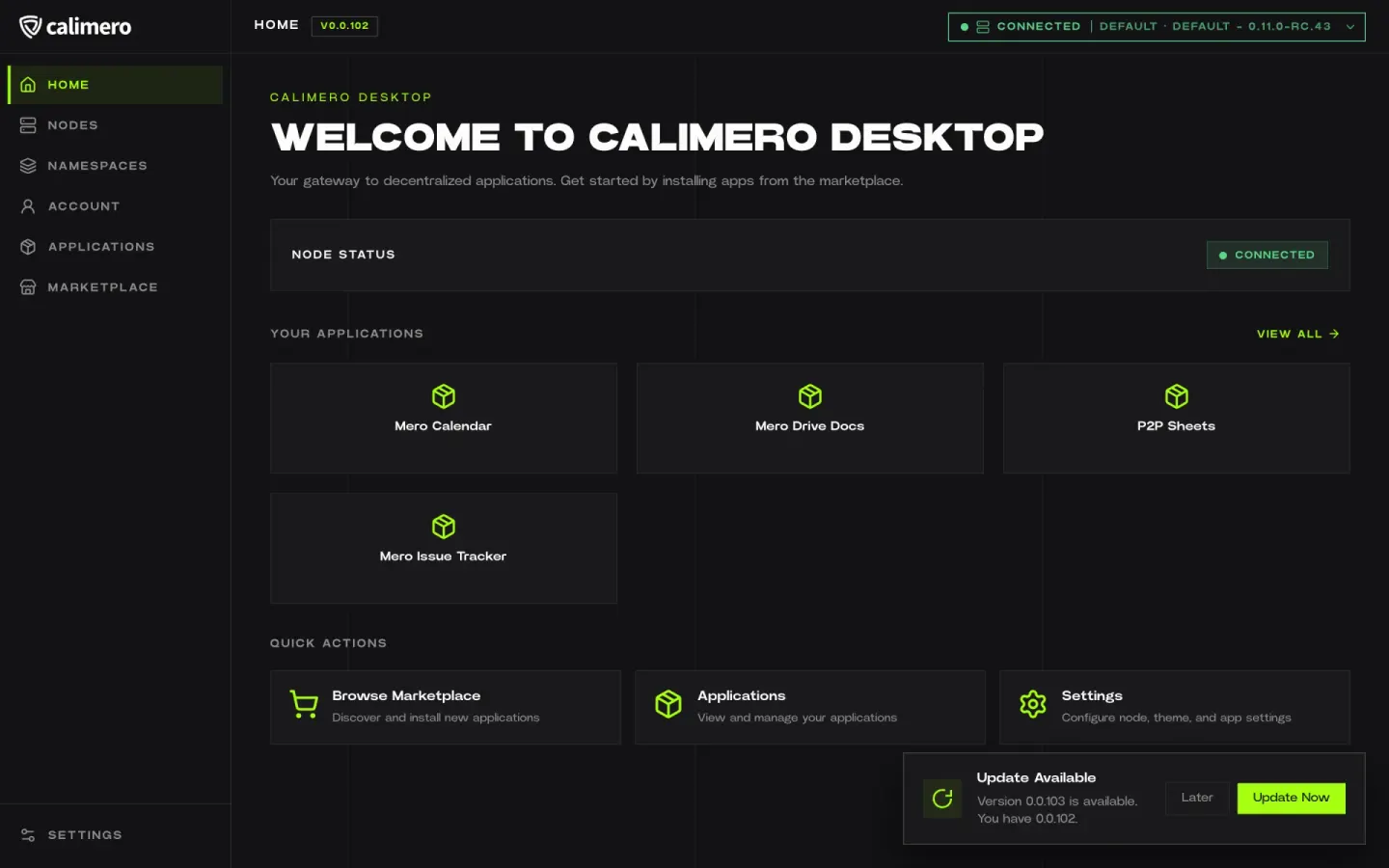
Calimero Desktop
HomeConnecteddefault

Calimero Desktop

Welcome to Calimero Desktop

Your gateway to decentralized applications. Get started by installing apps from the marketplace.

Node statusConnected
Your applications

Mero Calendar

com.calimero.mero-calendar

A collaborative, peer-to-peer calendar on the Calimero network. Shared team calendars and more.

v0.1.0

Mero Drive Docs

com.calimero.mero-drive-docs

Namespace-based document workspace — registry + docs multi-service bundle.

v10.1.3

Quick actions

Install an app from the Marketplace, open it, and drag its window by the title bar.

01What it does

Everything your node needs, in one app.

  1. Your node

    Your own node, set up in a minute.

    Calimero Desktop ships with the node built in. The first launch creates a node on your computer and the admin login you will sign in with — no terminal, nothing else to install.

    • The node software comes bundled with the app
    • You choose the admin username and password
    • Or connect it to a node you already run, local or remote
  2. Application Registry

    Find an app. Install it. Open it.

    The Marketplace lists the applications in the registries you have configured. Search, filter by category or by what is installed, read an app’s page with its screenshots and links, pick a version and install it onto your node.

    • Search and category filters across every registry
    • Pick which version to install
    • Each app opens in a window of its own
  3. Namespaces

    A namespace for your team, and an invite to it.

    Namespaces are grouped by the app they belong to. Create one, see its contexts and who is in it, invite someone with a link, or join a namespace from an invite you were sent.

    • Create a namespace from the app it belongs to
    • Invite people, see members, start new contexts
    • Namespaces and Nodes appear once Developer Mode is on in Settings
  4. Account

    Every device you own, on one account.

    The Account page lists your devices and what each may act for. Add a device by carrying a pairing invite to it, and choose whether it gets everything or only the apps you pick. Revoke one when you stop using it.

    • One account across all your devices
    • Everything, or only the apps you choose
    • Revoke a device you no longer use
  5. Nodes

    Run more than one node, and watch them work.

    Create more nodes, each on its own ports and node version, then start, stop and restart them from the Nodes page. The log viewer follows a node live, with a filter, copy and download.

    • Each node keeps the version it was created with
    • Start, stop and restart without a terminal
    • Live logs you can filter, copy and download
  6. Calimero Cloud

    Always on, one sign-in away.

    Turn on Cloud in Settings and sign in to link Calimero Cloud: your plan shows in the app, and your namespaces can stay online while your computer sleeps.

    • Sign in to Calimero Cloud from Settings
    • See your plan, manage it on cloud.calimero.network
    • Disconnect at any time
  7. Appearance

    Dark or light.

    The whole app follows one design in two themes. Switch between them in Settings.

    • Every page in both themes
    • Switch in Settings, under Appearance

02And more

And the quieter parts.

  • An Update Available prompt offering Update Now or Later

    Updates arrive on their own

    The app checks for new versions and offers to update now or later.
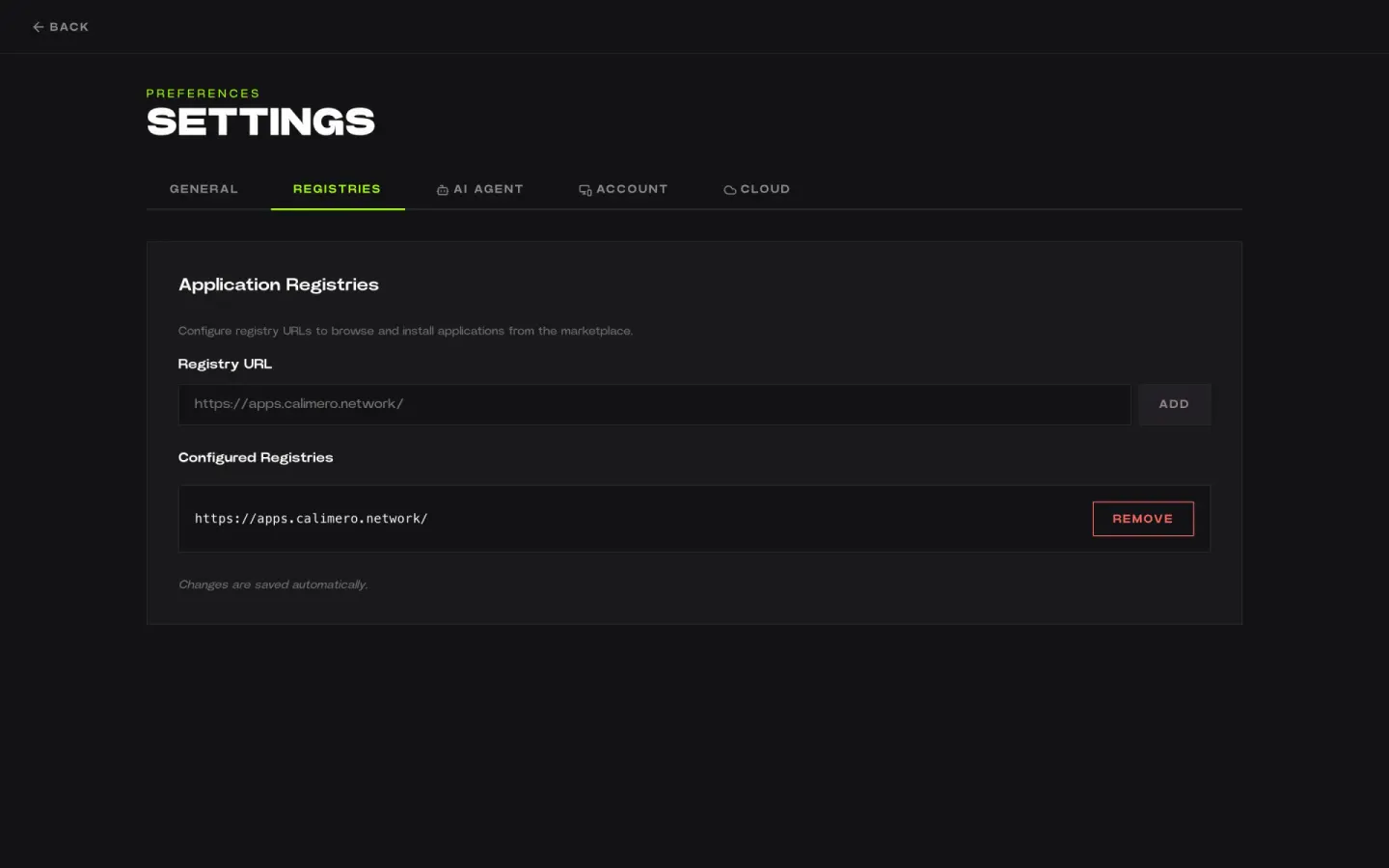
  • Settings, Registries tab: the configured registry apps.calimero.network

    Choose where apps come from

    Add or remove the registry URLs the Marketplace reads from.
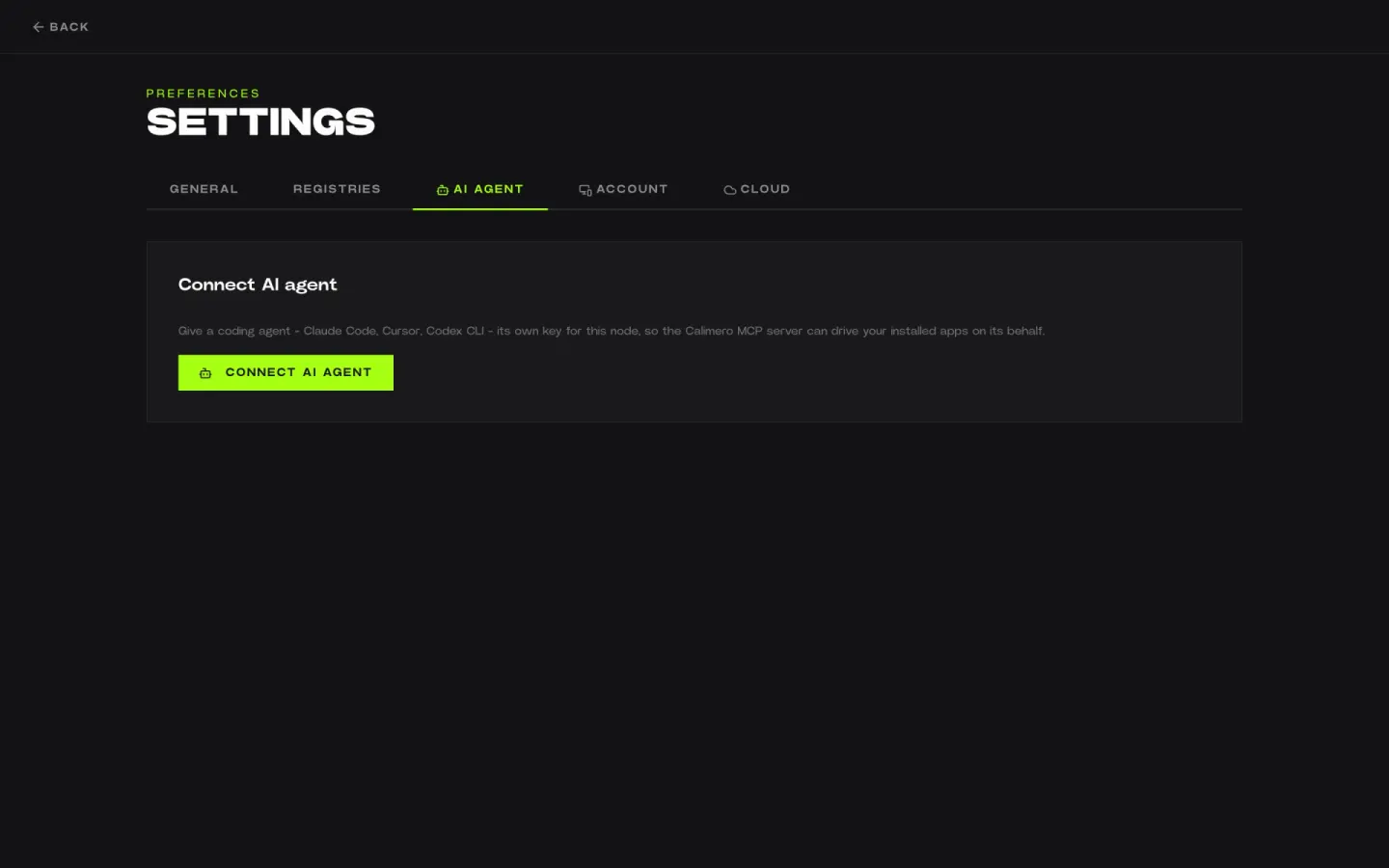
  • Settings, AI agent tab: Connect AI agent

    Connect an AI agent

    Give a coding agent — Claude Code, Cursor, Codex CLI — its own key for your node, so the Calimero MCP server can drive your installed apps.

03Get started

From your laptop to your whole team, in four steps.

  1. 1

    Set up

    Get Calimero Desktop. It runs your node.

    Download →
  2. 2

    Create

    Install an app. It creates your namespace: the app’s own private space for its data, people and rules. You’re the admin.

    Explore applications →
  3. 3

    Keep it on

    Turn on always-on. Sealed cloud machines keep it online while you sleep.

    Go always-on →
  4. 4

    Invite

    Send one link. People join from Desktop or the browser — and with always-on, even while you’re offline.

    How invites work →

A namespace is an app’s own private space — its data, its people and its rules.

04Always on

Calimero Cloud

Keep it online while you sleep.

We run sealed, always-on machines for your namespaces — so your team stays in sync and people can join from any browser. Even we can’t read what’s inside them.

  • Always onYour namespace stays online while your devices are off.
  • Sealed hardwareIntel TDX machines prove what they run before they get a key.
  • Any deviceBrowsers and phones join and write with a signed request — no install.
Start with Calimero CloudHow it works →

05Requirements

System requirements

  • macOS

    • macOS 10.15 (Catalina) or later
    • Apple Silicon or Intel processor
    • 100 MB available disk space
  • Windows

    • Windows 10 (64-bit) or later
    • x64 processor
    • 100 MB available disk space
  • Linux

    • Ubuntu 20.04+, Fedora 35+, or equivalent distro
    • x64 processor
    • 100 MB available disk space
    • WebKit2GTK 4.0
  • Chromebook

    • ChromeOS with the Linux (Crostini) environment enabled
    • ARM64 (aarch64) processor
    • 100 MB available disk space
    • Install the .deb via the Files app, then launch from the launcher